Laser Cladding Machine

Company Profile


Shandong Qiangyuan Laser of SDIIT Ltd. (SDQY Laser) founded by Laser Institute of Shandong Academy of Science since 1978. A leading enterprise focusing on the R&D, manufacturing, sales and service of laser cleaning, welding, cutting, cladding machines and solutions.


SDQY Laser has a multi-disciplinary doctoral innovation team composed of optical, mechanical, electronic, computer, materials science and other specialties.

Why Choose Us

Professional Team

The company relies on the Laser Research Institute of Shandong Academy of Sciences and has a multi-disciplinary high-level R&D and innovation team in optics, mechanics, electronics, etc.

Complete After-Sale Service

Our after-sales service team have professional skills and knowledge, and can provide accurate and effective solutions in installation guidance, usage training, parts replacement, regular maintenance, etc.

Safety Assurance

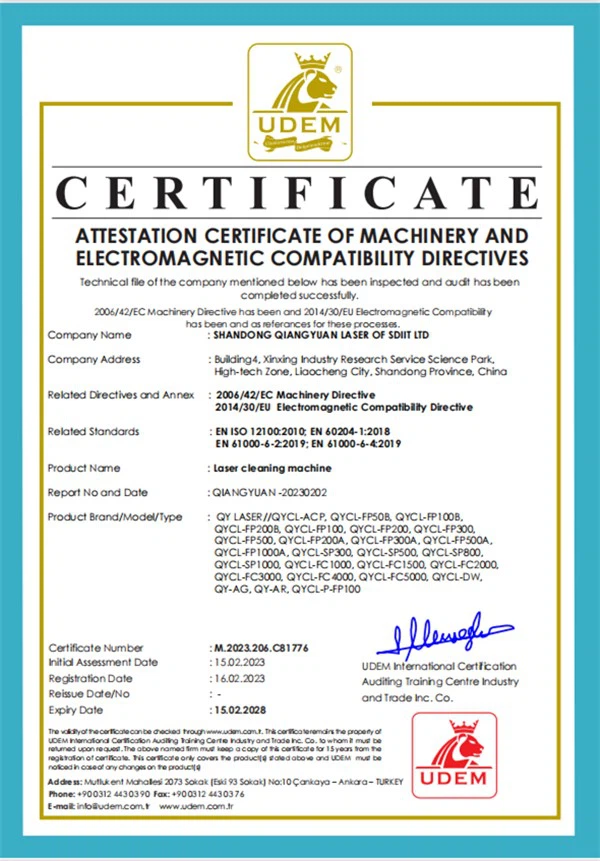
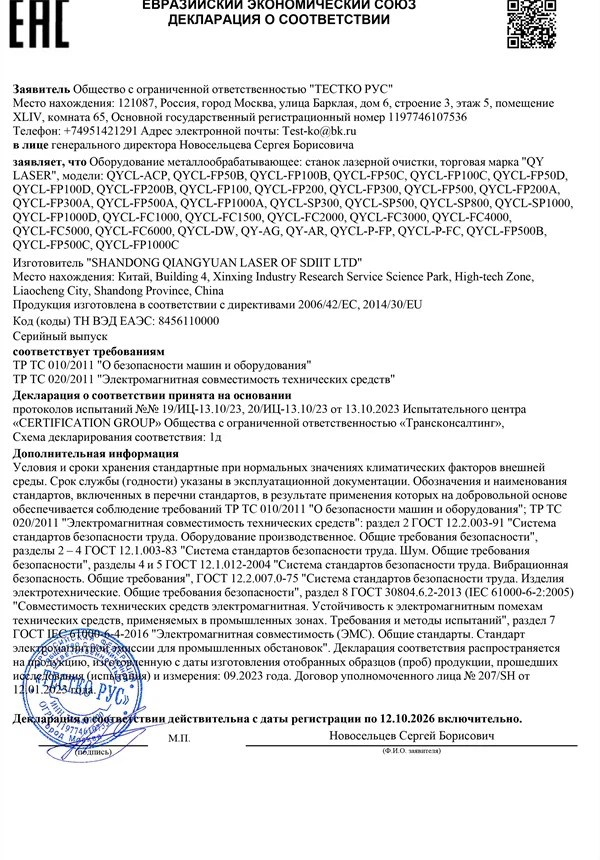
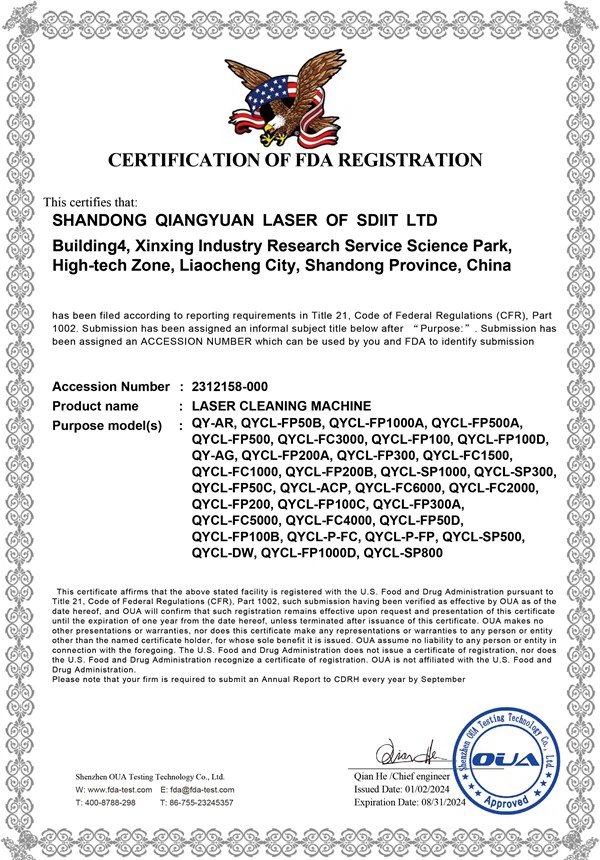
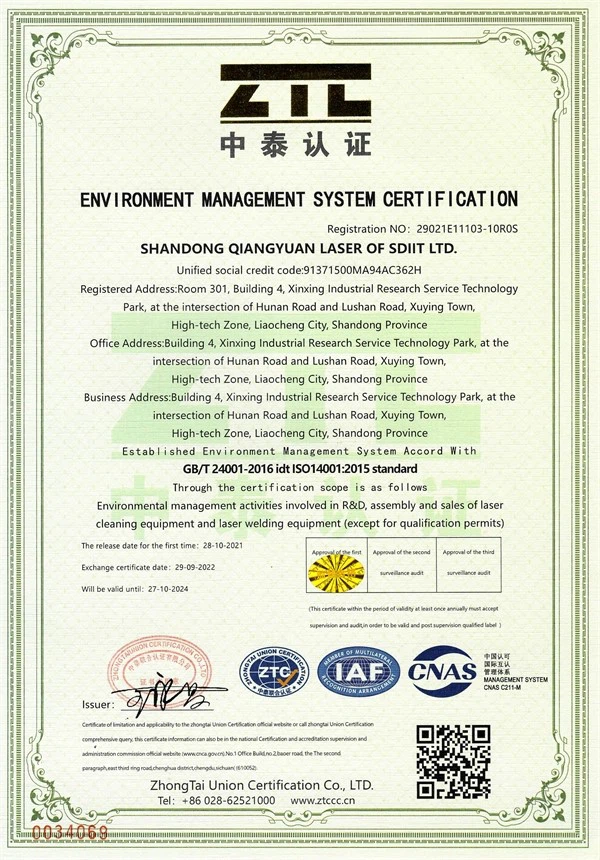
SDQY Laser has passed ISO9001, ISO14001, ISO45001, CE, EAC, FDA, SGS and other certifications.


Customization Requirements

Provide personalized services in terms of solutions, appearance design, etc. based on customers' specific needs and preferences.

What is Laser Cladding Machine?


Laser cladding is a sophisticated manufacturing process that involves the application of a laser beam to deposit a layer of material onto a substrate. The machine used for this purpose is known as a laser cladding machine. This innovative technology is widely employed in various industries for purposes such as surface coating, repair, and additive manufacturing.


The laser cladding process is a method of applying a fully dense, metallurgically bonded and virtually pure coating which can be used to increase the wear resistance, corrosion resistance or impact performance of metallic components.

Benefits of Laser Cladding Machine
 

Optimize the performance of the shaft surface.

An alloy coating with completely different components and properties can be formed on the shaft surface by laser cladding. Because the matrix melting layer is very thin, it has little effect on the composition of the cladding layer. We can prepare surface coatings with heat resistance, corrosion resistance, wear resistance, oxidation resistance, fatigue resistance or optical, electrical and magnetic properties according to specific needs, so as to effectively improve the performance of the shaft surface.


High metallurgical bonding strength.

In the process of laser cladding, the added cladding material completely melts, making it the subject alloy of the cladding layer.At the same time, the base alloy also has a thin layer of melting, which forms metallurgical combination with the subject alloy and is not easy to fall off, which solves the problem of poor bonding strength between the coating and the base in the cold working process such as traditional electroplating and spraying.


Low heat input, small deformation

Low heat input, small deformation, rapid heating and rapid cooling of laser cladding have little impact on the substrate, which solves a series of technical problems such as inevitable thermal deformation and thermal fatigue damage in the process of traditional electric welding, argon arc welding and other thermal processing.


Customized processing

The laser cladding machine is highly flexible and can be customized according to different needs. By controlling the movement and parameters of the laser beam, complex shapes, and precise dimensions can be processed to meet individual needs.


Types of Laser Cladding Machine
 

CO2 (Carbon Dioxide) Lasers
These gas-based lasers can generate extremely high levels of power. They are commonly used in cladding applications that demand deep penetration. CO2 lasers work by electrically discharging carbon dioxide gas molecules, causing the molecules to emit photons of light at a specific wavelength of around 10.6 micrometers.


Fiber Lasers
They are solid-state lasers that use fiber optic cables as their lasting medium. These solid-state lasers transmit their laser beam through optical fibers. They can provide cladding of excellent quality with a smooth surface finish. Due to their high power output, superior beam quality, and effective operation, these lasers are widely used in several laser-clad applications.


Nd: YAG Lasers
Nd: YAG (neodymium-doped yttrium aluminum garnet) lasers are solid-state lasers and are commonly used in laser cladding. Neodymium-doped yttrium aluminum garnet crystals are used as the lasing medium in Nd: YAG lasers. They can provide a wide range of power densities and have a high pulse repetition rate.


Diode Lasers
These semiconductor-based lasers are usually employed in low-power applications like laser cladding. A p-n junction diode is a more lasing medium.

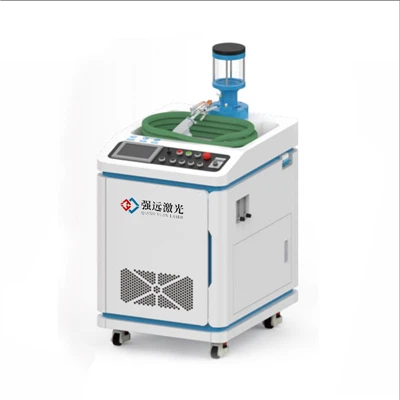
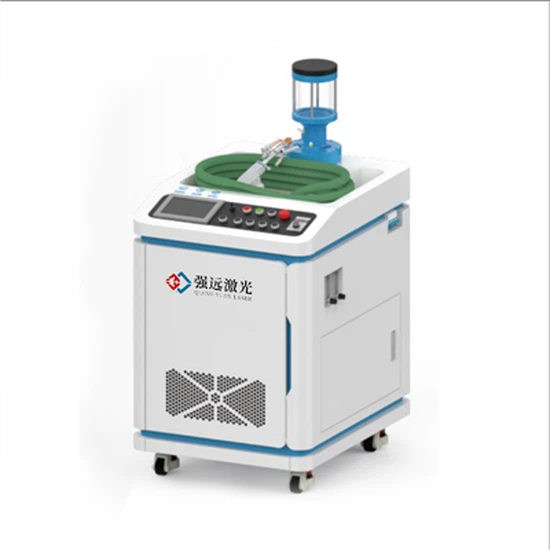
Handheld Laser Cladding Machine
How to Choose Your Right Laser Cladding Machine


Laser cladding, an emerging surface treatment technology, has been widely popularized and applied in metal surface modification and metal spare parts repair in large area.


As for cladding materials, there is a wide range of varieties, such as nickel-, iron-, cobalt-base alloy and ceramic phase materials, of which composition is free from metallurgical thermodynamics. Using laser cladding, high-melting materials can be cladded on the surface of low-melting substrate. When cladding layer binds up with substrate to form a metallurgical bonded coating after solidification, the substrate materials will be much higher in resistance to wear and corrosion.


When using preset powder feeding, it means that alloy powder will be covered on substrate surface in advance, then, laser beam scans across pre-cladding layer. After taking in laser energy, the above layer rises in temperature and begins to melt. Meanwhile, the surface heat is passed inwards through heat conduction. As a result, a metallurgical bonded coating is about to take its shape after laser beam leaves and the molten metal quickly solidifies on substrate surface. Its advantages are high efficiency, uniform coating layer and firm binding with substrate. But, it also has the disadvantages of inflexibility and failure of cladding some special-shaped and small workpieces. This technically mature craft is now applied in the strengthening of axle parts of coal mine machinery, steelworks, petroleum drilling and so on.


In regard to synchronized powder feeding, special powder feeder, together with powder feeding pipe and airflow, is usually used to feed alloy materials to the waiting area. Now, the mainstream type lies in coaxial feeding, that is, powder and laser arrive at substrate surface simultaneously. In this way, the substrate receives less heat input, better quality of cladding layer and lower degree of surface roughness. At this moment, only simple work is needed to make cladding layer much smoother. Hence, this mode is fitted for cladding the special-shaped workpieces. Working with a manipulator, complex stereo workpiece is also easy to be cladded without any disassembly. As thus, this laser cladding will be high in speed when coaxial powder feeding is put into use. In spite of its maturity, it is highly demanding on powder feeding devices, shielding gas, cladding units, etc.


Materials Used In Laser Cladding Machine


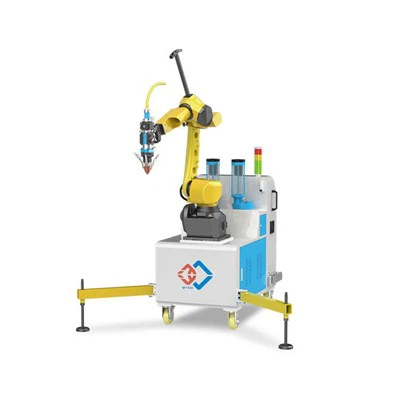
Movable Robot Laser Cladding Machine Industrial Repair Rebuild Refurbishment

Laser cladding machine is a process that uses a laser beam to melt and deposit a material onto a substrate to create a coating on the surface of the material. Depending on the desired quality of the coating and the specific application, different materials can be used for this process.


Metal powders. The laser cladding process uses different metal powders, such as titanium, aluminum, cobalt-based alloys, and nickel-based alloys.


Ceramic powders. For laser cladding, ceramic particles such as aluminum oxide, zirconium oxide, carbides can also be used, and tungsten can also be used.


Composite powders. Coatings with special properties can be made using composite powders, which are a combination of metal and ceramic powders.

Carbides such as tungsten carbide and chromium carbide are often used in laser cladding due to their high hardness and wear resistance.


Diamond particles. Laser cladding materials can be supplemented with diamond particles to increase wear resistance and reduce friction.

Laser cladding can use polymers such as polyamide to create coatings with excellent wear resistance and low friction.


Glass powder. Glass powder helps produce laser cladding coverings with unique optical and thermal properties.

 
Applications of Laser Cladding Machine
 
01/

Aerospace
In aerospace sector, laser cladding is usually used to repair and enhance critical components such as turbine blade, engine parts and landing gear. The process improves the wear resistance and service life of these high-stress components.

02/

Automotive Production
Laser cladding is employed to improve the performance and durability of automotive components like camshafts, crankshafts and brake discs. The process helps in achieving high-precision coatings that withstand the demanding conditions of automotive operations.

03/

Oil and Gas
Components used in oil and gas industry, such as drilling tools, valves and pipelines, also benefit from laser cladding. This method makes these components more resistant to wear and corrosion, extending their operational life in harsh environment.

04/

Mining and Construction
In general, heavy machinery and equipment in mining and construction face extreme wear and tear. Laser cladding is used to reinforce the surface of these components, improving their resistance to abrasion and impact.

05/

Medical Device
In medical field, laser cladding is utilized to coat surgical instruments and implants with biocompatible materials. This enhances their functionality and longevity, ensuring better patient outcomes.

06/

Tool and Die
The tool and die industry makes use of laser cladding to repair and enhance the performance of molds, dies and cutting tools. It restores these tools’ dimensions and surface properties and reduces possible downtime and production costs.

 
How Laser Cladding Machine Works

In general, arc welding techniques provide an all-welded metallurgical bond with high strength, good impact properties and low porosity. However, the high heat input into the part will usually melt enough of the base material to allow substantial mixing of the base material into the cladding. This dilution is undesirable as it alters the properties of the chosen cladding material. In addition, high heat input causes mechanical deformations that require further processing after cladding to restore the dimensional accuracy of the part. This thermal stress leads to poorer mechanical quality, surface quality issues such as cracks and porosity, and shortened life of repaired parts.


Lasers are driving this trend in many industries because of their ability to perform highly precise, non-contact processing. Cladding, in particular, is the process by which these purposes are achieved. The repair and refurbishment industry for production engineering is experiencing positive growth as the economic pressures to keep machinery running, thereby reducing our carbon footprint in landfills, change. With the rapid growth of laser applications and the reduction in the cost of laser systems, laser material processing is being successfully implemented in automotive, aerospace, shipbuilding and ship repair, oil and gas drilling, and many other industries.


By definition, laser cladding machine is a method of depositing material by which powder or wire stock is melted and solidified using a laser to resurface or create near-net-shape parts, such as in additive manufacturing. In many cases, laser cladding technology is used in the repair and refurbishment of all types of machinery and equipment. The most common traditional methods of metal cladding are all variations of the electric arc process.


This procedure is widely used in the marine and industrial sectors such as rapid manufacturing, repair of spare parts, hardfacing/coating and many more applications. CNC cladding battery machines combined with laser cladding technology make everything repairable and viable.

What is the difference between laser cladding and laser welding?
 

Laser cladding and laser welding are both laser-based processes used in manufacturing, but they serve different purposes and have distinct applications.

Laser Cladding

Laser cladding involves the deposition of a layer of material onto a substrate to modify its surface properties. This process is commonly used for surface coating, repair, and additive manufacturing. A high-powered laser beam is directed onto the substrate, creating a molten pool by melting a feedstock material (powder or wire) that is simultaneously introduced. The molten material solidifies, forming a bonded layer on the substrate. Laser cladding is often employed to enhance wear resistance, provide corrosion protection, or repair damaged components without affecting the entire part.

Laser Welding

Laser welding, on the other hand, is a process where two or more materials are joined together by melting and fusing them at the interface. The laser beam is precisely focused on the joint between the materials, generating enough heat to create a molten pool that solidifies to form a strong weld. Laser welding is commonly used for joining metal components in various industries, such as automotive, aerospace, and electronics. It is known for its high precision, minimal heat-affected zone, and the ability to weld complex geometries.

while both laser cladding and laser welding involve the use of lasers to manipulate materials, laser cladding focuses on depositing a layer onto a substrate for surface modification, while laser welding is dedicated to joining materials together through fusion at their interface.

 
Our Factory

SDQY Laser is a State-level High-tech Enterprise, Innovative Enterprises in Shandong Province, Advanced Laser Technology Innovation Center, Liaocheng New Research and Development Institution.


Our products has exported to European, American, Middle Eastern, Australian, African countries and regions, we provided customers with high quality laser solutions.

productcate-324-243
productcate-1-1
productcate-1-1
productcate-1-1
 
Certificate


productcate-1-1
productcate-1-1
productcate-1-1
productcate-1-1
FAQ

Q: What is a Laser Cladding Machine?

A: A laser cladding machine is a specialized tool that uses a laser beam to melt a coating material onto a substrate, creating a metallurgical bond. This process can restore worn surfaces or add corrosion-resistant layers.

Q: How Does Laser Cladding Work?

A: The laser beam melts both the coating material and the substrate surface simultaneously. As the molten pool solidifies, it forms a new layer with properties that differ from the original substrate, enhancing its performance.

Q: What are the Benefits of Laser Cladding?

A: Benefits include high precision, minimal heat input to the substrate, low distortion, and the ability to apply a variety of coating materials. It is also cost-effective for repairing and upgrading components.

Q: What Materials Can Be Used for Cladding?

A: Materials used for cladding include a variety of metals such as tungsten carbide, cobalt-based alloys, and nickel-based alloys. These materials are chosen based on the desired properties of the final layer.

Q: What Types of Lasers are Used in Laser Cladding?

A: Common lasers include fiber lasers, CO₂ lasers, and diode lasers. Each type has different power and wavelength characteristics, affecting the cladding process and the properties of the deposited layer.

Q: What are the Applications of Laser Cladding?

A: Applications range from repairing and restoring worn parts in the aerospace and automotive industries to enhancing components in oil and gas, mining, and tooling industries with wear-resistant or corrosion-resistant coatings.

Q: What are the Safety Precautions for Laser Cladding?

A: Safety measures include wearing personal protective equipment (PPE) to protect against the laser beam, high temperatures, and fumes. Ventilation is crucial to remove fumes and particulates generated during the process.

Q: What is the difference between laser cladding and laser welding?

A: Laser welding also provides the ability to join dissimilar materials for new battery generations. Laser cladding is a process that generates thin protective layers for high-value and critical components in a range of industries from food processing to transportation and energy.

Q: How Does Laser Cladding Compare to Welding?

A: Unlike welding, which joins two pieces of metal, laser cladding adds material to a surface. It results in less distortion and a more controlled heat-affected zone, making it suitable for precision applications.

Q: What is the Cost of Laser Cladding?

A: The cost depends on factors such as the size of the component, the material being clad, and the complexity of the job. Laser cladding can be more cost-effective than traditional methods for high-value components.

Q: What is the use of cladding machine?

A: The laser cladding process is a method of applying a fully dense, metallurgically bonded and virtually pure coating which can be used to increase the wear resistance, corrosion resistance or impact performance of metallic components.

Q: What are the benefits of laser cladding?

A: Benefits of laser cladding over alternate technologies include better metallurgy (bonding, hardness or porosity) as well as reduced part deformation and stress due to lower overall heat input. Thin-coat applications can be thinner, saving powder costs, and in most cases lasers have a significantly shorter cycle time.

Q: Can Laser Cladding be Used for Additive Manufacturing?

A: Yes, laser cladding can be used for additive manufacturing, often referred to as 3D printing. It is used to build complex geometries layer by layer, especially for components requiring high strength and specific surface properties.

Q: What Maintenance is Required for a Laser Cladding Machine?

A: Regular maintenance includes checking and cleaning the optical components, maintaining the gas supply, and ensuring the cooling system is functioning properly to protect the laser from overheating.

We're well-known as one of the leading laser cladding machine manufacturers and suppliers in China. Please rest assured to buy high quality laser cladding machine at competitive price from our factory. For customized service, contact us now.

Wire Feeder For Welding Machine, 2000W Laser Cleaning Machine, Mobile Laser Cleaning

(0/10)

clearall