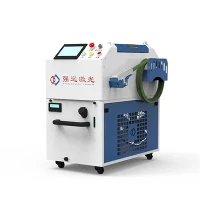

Laser Rust Removal For Ships: A Cleaner Surface Treatment Solution
Sep 23, 2026
Ships operate in harsh marine environments where moisture, salt spray, and oxidation cause rust and corrosion to gradually form on steel surfaces. During shipbuilding, repair, and maintenance, removing rust is a crucial step in surface pretreatment prior to painting, welding, or coating application.
Traditional rust removal methods-such as sandblasting, mechanical grinding, and chemical cleaning-are widely used but often involve abrasives, dust, and chemical waste; they are labor-intensive and may require additional surface pretreatment steps. Laser cleaning offers an alternative solution for specific ship maintenance and surface treatment applications.
How Does Laser Rust Removal Work?
The principle behind laser rust removal involves focusing a high-energy laser beam onto the rust. Upon absorbing the laser energy, the rust heats up rapidly, causing it to vaporize or be blown away by micro-explosions. Because rust and the underlying metal absorb laser energy differently, selecting the appropriate laser parameters allows for rust removal while minimizing thermal impact on the substrate.
Depending on specific application requirements, laser cleaning can also be used to remove paint, oxide layers, oil stains, and other surface contaminants.
Applications of Laser Cleaning in Shipbuilding and Ship Maintenance
Laser cleaning is suitable for various ship-related surface treatment scenarios, including:
- Rust removal from ship steel structures
- Paint and coating removal
- Surface pretreatment before painting
- Cleaning of weld seams and welded areas
- Removal of oxide layers from steel plates
- Localized cleaning of ship components
- Maintenance of marine machinery and metal parts
- Surface pretreatment prior to welding or repair
For large-scale applications, high-power laser cleaning machines can be integrated with automated equipment, while handheld systems offer greater flexibility for localized rust removal and the treatment of edges, weld seams, and complex areas.
Why Consider Laser Cleaning for Ship Rust Removal?
Compared to traditional abrasive or chemical cleaning processes, laser cleaning offers the following advantages:
- Non-contact cleaning: The laser beam cleans the surface without requiring mechanical contact with the substrate.
- Precise surface treatment: Laser parameters can be flexibly adjusted based on the type and thickness of the contaminants.
- No abrasives required: The process eliminates the need for sand, blasting media, or grinding consumables.
- Reduced chemical usage: Where applicable, laser cleaning minimizes the need for chemical cleaning agents.
- Operational flexibility: Handheld or automated laser cleaning systems can be selected based on the workpiece's size and geometry.
- Suitable for surface pretreatment: Capable of removing rust, paint, and oxide layers, preparing metal surfaces for subsequent coating, welding, or repair processes.
Laser Cleaning for Shipyards and Marine Engineering
For shipyards, ship repair facilities, and marine equipment manufacturers, selecting the right laser cleaning system requires considering various factors, including rust layer thickness, surface condition, cleaning area, substrate material, and production efficiency requirements.
SDQY LASER offers pulsed and continuous wave (CW) laser cleaning machines designed for industrial surface treatment-covering rust removal, paint stripping, oxide layer removal, and weld surface pretreatment.
Before purchasing laser cleaning equipment, we recommend conducting sample tests to determine the optimal laser parameters and cleaning results for specific marine vessels or engineering components.
Looking for a laser cleaning solution for ship rust removal? Contact SDQY LASER for an application assessment and sample testing.