


Laser Oxide Removal
May 19, 2023
Laser Oxide Removal
Before welding and several other surface treatments, metal surfaces must be clean and without oxides. Laser oxide removal can be used to remove those contaminants without introducing impurities in the base metal. Using the laser’s micron precision, oxide can be removed in controlled layers and from predefined areas.
Fiber laser cleaning systems can remove oxides from ferrous and non-ferrous metals alike. These systems stand out compared to chemical treatments, mechanical brushes and other common methods.

Aluminum Oxide Removal
Aluminum is widely used in metalworking for of its strength and lightweight. When exposed to the humidity and oxygen in the air, a gray oxide layer forms on its surface, acting as a protective barrier between oxygen and the base metal.
Laser cleaning is the best solution to remove oxide from aluminum. For example, oxide can be removed before welding to strengthen the welds. It can also be removed before several surface treatments, such as before a coating process to prevent the paint from peeling off.
Stainless Steel Oxide Removal
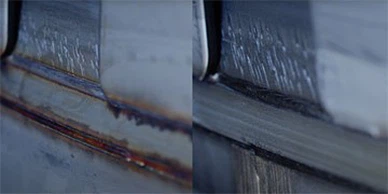
Stainless steel parts have the best resistance to corrosion and have a shiny surface finish. But when welded, the high-temperature areas around the welding joints blacken, which prevents complete passivation, invites rust and diminishes the part’s aesthetics.
Fiber lasers are used to completely remove black oxides in record time, ensuring that the welding joints passivate properly, and that the part’s aesthetics is preserved.
WHY USE LASER TECHNOLOGY FOR OXIDE REMOVAL
1. Automated Solutions
Replace manual and labor-intensive cleaning solutions with an automated and repeatable process.
2. No consumables
Remove oxide layers without abrasives which damage your machines and chemicals which require special handling procedures and powerful exhaust fans.
3.Maximum Uptime
Our cleanings systems are made with industrial grade components to continuously remove oxides for years with minimal maintenance.
4. Guaranteed Safety
Integrate a technology that is safe and does not require PPE with our Class 1 certification services and fume management expertise.
HOW DOES LASER OXIDE REMOVAL WORK?
When you focus a laser beam on a surface, a large quantity of its energy is transferred to the targeted material. If that energy is superior to the material’s ablation threshold, the material will undergo sublimation or vaporization. This reaction called laser ablation is used to remove contaminants and oxides.
Oxides have an ablation threshold well below that of most base metals. Hence, we can adjust the laser parameters so that the oxide is removed without damaging the base metal. Different types of oxides have different ablation thresholds. For example, light-orange rust and black oxide generated near welding areas have a lower ablation threshold than mill scale layers and are thus removed faster. In fact, most oxides are quickly removed in a single laser pass.


