


Laser Cladding Remanufacturing Technology
Mar 26, 2024
With the continuous development of modern science, technology and industry, the working environment of parts and components is becoming more and more complex, and the requirements for surface properties are getting higher and higher. Therefore, the scrap rate of parts has greatly increased. Parts that are usually scrapped due to surface failure include: rotor blades, shaft parts, gear parts, molds, etc.
Parts with only surface damage can be repaired under the condition that the overall performance of the parts meets the working conditions. If parts scrapped due to misprocessing or service damage can be repaired, not only can huge economic and time losses be recovered, but also resource utilization can be improved.
Current methods for repairing parts include laser cladding, vacuum brazing, vacuum coating, tungsten inert gas welding (TIG) and plasma cladding repair. Laser cladding is based on the working conditions of the workpiece, cladding metals or non-metals with various design components to prepare surface coatings that are heat-resistant, corrosion-resistant, wear-resistant, oxidation-resistant, fatigue-resistant or have optical, electrical and magnetic properties.

Laser cladding is a rapid cooling process. During the cladding process, the heat input to the repaired workpiece is small, the heat affected zone is small, the cladding layer has a fine structure, and it is easy to implement automation. Therefore, laser cladding is used to repair the rotor. Other parts have greater advantages than other methods. Laser cladding technology solves a series of technical problems such as thermal deformation and thermal fatigue damage that are inevitable during thermal processing such as traditional electric welding and argon arc welding. It also solves the bonding strength between the coating and the substrate during cold processing such as traditional electroplating and spraying. Poor contradiction, which provides a good way for surface repair.
Introduction to Laser Cladding Process
For mechanical parts with wear, corrosion, creep, fatigue, and fracture failure, laser cladding technology is used to simultaneously feed alloy powder into the molten pool and rapidly solidify to form a cladding layer with special properties. The cladding layer has no pores and crack defects, and the hardness range is 20~60HRc, which can meet various working conditions and performance requirements. Suitable for cladding/remanufacturing of various large parts with complex shapes, restoring the size and performance of failed parts, upgrading surface properties, and extending service life.
Laser Cladding Process Characteristics
Low heat input, small heat affected zone, small deformation, and only a small amount of machining required;
Reduce alloy material loss;
The dilution rate is less than 1%, which can maintain the specific properties of the cladding layer;
Flexibility, automation, short processing cycle, low cost, and performance better than new products;
Metallurgically combined with the matrix, with high bonding strength;
Using special alloy powder, the cladding layer can have wear resistance, corrosion resistance, fatigue resistance and other properties;
The cladding layer structure has a complete fine-grained structure and excellent strength and toughness.

Application of Laser Cladding Technology
1. Repair of rotor blades
Rotor blades are key parts that directly affect engine performance, reliability and life, and their working conditions are very harsh and easy to be damaged, so the requirements for material performance have also been greatly increased. The application of laser cladding technology on rotor blades has been well studied, which also provides a favorable prerequisite for its application in repair.
2. Repair of shaft parts
Usually, the main causes of failure of shaft parts include shaft deformation, shaft fracture, and shaft surface failure. Using high-power laser cladding repair technology, a layer of iron-based alloy material can be laser cladded on the failed surface of shaft parts, so that the surface of the clad alloy layer has good mechanical properties, and the scrapped parts can be reused.
3. Mold repair
Mold plays an important role in casting molding and plastic molding processing. Its manufacturing process is complex, the production cycle is long, and the processing cost is high. Therefore, repairing and reusing failed molds undoubtedly has significant economic benefits. Laser cladding has become a research hotspot for repairing molds and has attracted much attention.
The method of laser cladding to repair the surface wear of the mold can be summarized as follows: using a high-power laser beam with a constant power P and a hot powder flow to be incident on the mold surface at the same time, part of the incident light is reflected, part of the light is absorbed, and is instantly After the absorbed energy exceeds a critical value, the metal melts to create a molten pool, which then solidifies rapidly to form a metallurgically bonded cladding. The laser beam scans back and forth to repair the mold line by line and layer by layer according to the route given by the CAD secondary development application. In particular, the repaired mold requires almost no reprocessing.
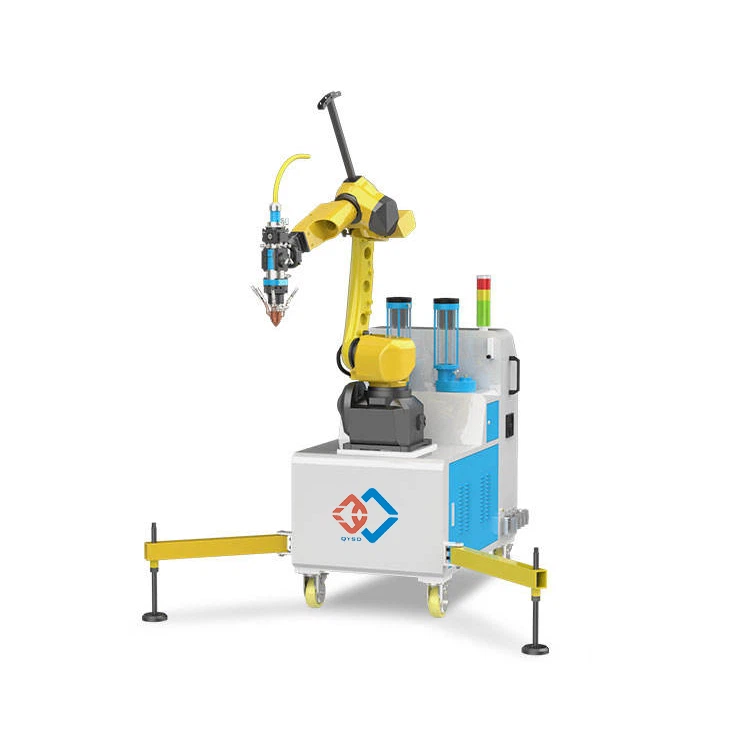


Application Fields:
Used in electric power (steam turbine rotors, blades), mining (gears, drill bits, hydraulic rods), machinery (shafts, gears), petrochemicals (turbine discs, rotors, push rods), ships (crankshafts, engine blades, camshafts), The remanufactured parts of locomotives (shafts, turbine blades, bogies, pistons), molds (stamping dies, forging dies, die-casting dies) and other industries are of reliable quality and have good economic and social benefits.


