
How To Protect Laser Optics From The Dangers Of UV Damage?
Sep 27, 2023
Laser optics are an important component of many types of lasers, including commercial, industrial, medical, and scientific lasers. However, UV laser optics often have a limited service life due to two main reasons: laser-induced contamination (LIC) and UV fatigue. LIC is caused by the deposition of unwanted material on the surface of the optic, while UV fatigue is caused by accumulated material. Exposure to UV light can cause damage to optics. Over time, these two damage processes degrade the performance of the optic.
What is Laser Induced Contamination (LIC)
Optical components can become contaminated when UV lasers interact with particles, water vapor, organic matter, and other contaminants in the system. These contaminants can come from ambient air, optomechanical equipment, and other materials in the system. Although mitigation methods such as dry nitrogen ventilation are helpful, they may still lead to LIC. Any accumulation of particulate matter blocks the light path, reduces component functionality, and may lower the laser damage threshold of the optic.
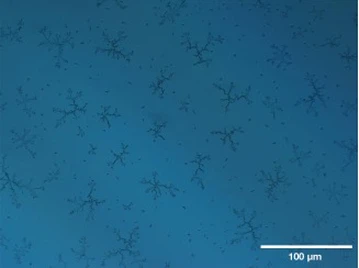
Due to low thermal conductivity, condensation often occurs on optical surfaces. These condensed water molecules can then interact with the laser and surface material, initiating LIC. Additionally, gaseous emissions and other airborne molecular contaminants often lead to the formation of carbon-based deposits on optical surfaces. The tree-like growth of LIC can be observed in Figure 1 .
What is UV fatigue?
In addition to environmentally induced LIC, materials used in coatings and substrates are susceptible to degradation over time due to optical fatigue processes, even if the light source intensity is below the laser-induced damage threshold (LIDT).
The concept of UV fatigue can be compared to binding a book. Even light use can cause wear and tear. UV fatigue experiments conducted by Edmund Optics have shown that under certain conditions, such as vacuum, UV laser exposure can cause UV fatigue effects. The difference between LIC and UV fatigue is that LIC is a cumulative process, while fatigue is the damage to light. material, causing discoloration or other intrinsic changes that may even result in removal of the material.
Two phenomena that determine the conditions and mechanisms for significant optical performance degradation are below the single-pulse damage threshold in the short-pulse laser range.
The first mechanism is based on changes in the refractive index, producing a lens effect that increases the local light intensity on the optical element.
The second mechanism involves the formation of photoinduced defects through the formation of self-trapped excitons, leading to the accumulation of absorption centers and loss of optical efficacy.

Both LIC and optical fatigue can occur, albeit to a lesser extent, in lasers at visible and infrared wavelengths. However, the high energy of UV photons makes these effects more common in systems emitting in this spectral range.
How to Protect Laser Optics from the Dangers of UV Damage?
One way to protect laser optics from UV damage is to use protective coatings. These coatings are designed to block the penetration of UV radiation and protect against its harmful effects. Some of the most popular coatings include anti-reflective coatings (which reduce the amount of UV radiation that reaches the lens) and anti-UV coatings (which completely block UV radiation).
Another way to protect laser optics from UV damage is to store them properly. When not in use, lenses should be kept in a dark environment away from UV radiation. Additionally, lenses should be stored in a clean, dry place free of any debris or moisture that could cause damage over time.
Regular cleaning is also important to keep your laser optics in good condition and protect them from UV damage. Proper cleaning involves using a soft cloth or brush to remove dirt or debris from the lens, then gently washing it with a mild cleaning solution. It is important to avoid exposing the lens to any harsh chemicals or solvents that may cause irreparable damage.
In summary, protecting laser optics from UV damage is critical to maintaining their performance and extending their service life. By using protective coatings, proper storage, and regular cleaning, laser optics can stay in top condition for years to come.